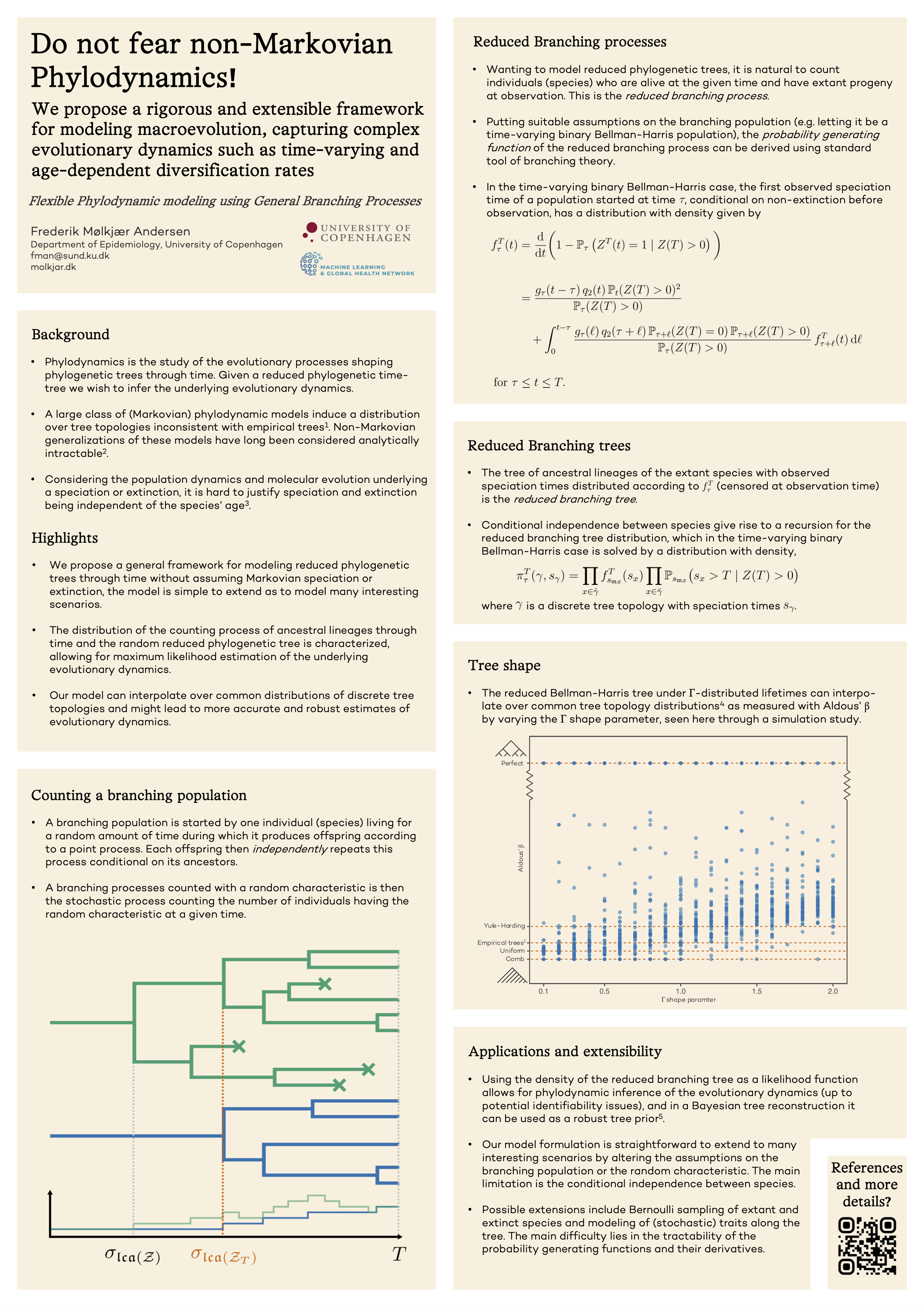
Flexible phylodynamics modeling using general branching processes
🌳 Hello! Great that you want to know more about branching processes and phylodynamics
🚧 At the moment we have a fully developed theory for the Bellman-Harris case of the model, and we are working on the characterization in the general Crump-Mode-Jagers case and in situations with Bernoulli random sampling. So, as this is still work-in-progress, nothing is yet published. Instead I have here collected some small comments on our approach, and a bunch of references to the literature, where you can learn more about these topics. Whenever we have a preprint up, I will post the link here and on my main website.
📏 Much of the theory here is work done in my Master's thesis, and if you'd really like to read more about this now, you can find my thesis here. But be aware, it is very long and quite technical as it builds everything from scratch using measure theory1.
📨 If you have any questions you didn't get to ask me at the poster session, just shoot me an email on fman@sund.ku.dk
The poster itself
The actual content on this site continues under the poster.
References for poster
If you are just here for the poster references, here you go:
Stadler, T. Recovering speciation and extinction dynamics based on phylogenies. J of Evolutionary Biology 26, 1203–1219 (2013).
Hagen, O., Hartmann, K., Steel, M. & Stadler, T. Age-Dependent Speciation Can Explain the Shape of Empirical Phylogenies. Systematic Biology 64, 432–440 (2015).
Rolland, J. et al. Conceptual and empirical bridges between micro- and macroevolution. Nat Ecol Evol 7, 1181–1193 (2023).
Aldous, D. Probability Distributions on Cladograms. In: Aldous, D., Pemantle, R. (eds) Random Discrete Structures. The IMA Volumes in Mathematics and its Applications, vol 76. Springer, New York, NY. (1996).
Khurana, M. P., Scheidwasser-Clow, N., Penn, M. J., Bhatt, S. & Duchêne, D. A. The Limits of the Constant-rate Birth–Death Prior for Phylogenetic Tree Topology Inference. Systematic Biology 73, 235–246 (2024).
Branching populations
Our whole framework is based on the classical construction of branching processes which can briefly be describes as follows.
Consider the space of all possible individuals in a population stemming from a single ancestor which can have an arbitrary number of offspring. This is called the Ulam-Harris space/population.
Endow each individual in this population with a probability space containing all the necessary information about all possible lives of the individual.
Consider the product probability space of all these individuals' probability spaces, endowed with the additional characteristic that the distribution of an individuals' life is determined completely by its ancestors' lives, and in particular that it is independent of all other individuals given its ancestors.
This approach allow us to define branching processes, branching trees and everything else we need, but it is still such a general setup, that we can impose a very large number of variations on the population dynamics suiting it for a given application. Having this construction at hand, we can derive the branching property, which is a central lemma for proving roughly anything about branching processes.
For more about this construction read either Harris' book6 or Jagers' amazing paper7
Harris, T. E. The Theory of Branching Processes. Die Grundlehren der Mathematischen Wissenschaften 119. Springer, Berlin (1963).
Jagers, P. General branching processes as Markov fields. Stochastic Processes and their Applications 32, 183–212 (1989).
Counting branching populations
Branching processes gain their incredible flexibility from letting us count different individuals of this branching population, through a random characteristic. The classical branching process is counting the number of individual in the branching population alive over time. But we could likewise count all individuals who had ever lived. In our phylogenetic framework it is natural to count individuals who are alive and who has extant progeny. The only constraint on the random characteristic is that it should only depend on the given individual, its ancestors and its progeny.
For more about random characteristics, see Jagers' book8
Jagers P. Branching processes with biological applications. Wiley, London (1975).
The distribution of the reduced branching process
Characterizing the distribution of a branching process is a relatively standard task, one uses the principle of first generation giving the recursive form of the probability generating function of the distribution, and the branching property to express this generating function. In practice it can be quite a daunting task however, and you seldom arrive at any explicit characterizations. But what you can often get is an integral equation for the generating function, which can then be studied further or numerically approximated. Any distributional quantities you would like can then be found from the generating function through taking derivatives and evaluating in the appropriate values.
For more on probability generating functions, just go to wikipedia, for derivations of generating function see Harris book6, or my thesis.
Reduced branching trees
Being able to characterize the first jump time of the reduced branching process, we can construct the reduced branching tree, as having branch length corresponding to this time. Characterizing its distribution is thus a task of considering the density of the branch lengths (and the probability of the pendant edge lengths), and this is easy to imagine, but if you want to delve further into the underlying probability/measure theory, you need to construct the actual measure space of branching trees and a dominating measure for the density of a tree to be well-defined.
As far as I know the measure theoretic construction is not done anywhere else than in my thesis (let me know if I'm wrong). You can however take a different approach as done e.g. by Amaury Lambert9, but this is tough to extend to situations with non-Markovian speciations (we are however trying to see if we can do it, let me know if you have any ideas!).
Lambert, A. The contour of splitting trees is a Lévy process. Ann. Probab. 38, (2010).
Solving integral equations
In practice we need to solve a number of integral equations numerically, which can be computationally quite heavy, depending on how complicated the model is. In the Bellman-Harris case we mostly have to solve linear integral equations, and these are quite efficient to numerically solve with quadrature rules (e.g. the trapezoidal rule), another approach is to realize that these equations are convolutions and to employ fast Fourier transforms as suggested in the paper by Graham Jones10.
You might question whether these solutions are actually unique? Don't worry, we have a proof that this is the case.
Jones, G. Calculations for multi-type age-dependent binary branching processes. J. Math. Biol. 63, 33–56 (2011).